
Essential Power Tools Every Tradesperson Should Own
Get the core kit right and almost every job gets easier — get it wrong and you spend years buying the same tool three times over.
Ask ten tradespeople for a list of essential tools for tradesmen and you will get ten different answers, because the “right” kit depends on the work you actually do most weeks. What doesn’t change is the thinking behind it: buy for your day-to-day work first, spend where failure costs you money, and commit to one battery platform early. This guide covers how to build a reliable core kit, the power tools that count as non-negotiable, where quality is worth paying for and where it isn’t, why sticking to one battery ecosystem matters more than any single tool, and the safety kit that has to sit alongside it all.
Building a Reliable Core Kit
A core kit is the small group of tools you would replace immediately if the van were emptied tonight. Everything else is a specialist purchase you can add as the work demands it.
The most common mistake is buying for the job you might do one day rather than the jobs you do every week. A kitchen fitter and a groundworker both need drills, but almost nothing else on their lists overlaps. Start by writing down the five tasks you carried out most often over the last month, then buy the best tools you can afford for those five. Specialist kit — a wall chaser, a mitre saw, a diamond core drill — earns its place later, and can often be hired for the first few jobs until you know how much you’ll really use it.
Two other things separate a reliable kit from an expensive pile of tools. The first is duty rating: DIY-grade tools are built for occasional use, and running them eight hours a day is what kills them, not bad luck. The second is consistency: the same platform, the same battery, the same charger, so a flat pack or a missing charger never stops the job. Build the kit gradually, buy bare tools once you have batteries, and resist the big-box combo deal that bundles four tools you need with three you don’t.
The Non-Negotiables
These are the power tools that pay for themselves across almost every trade. If you’re starting from scratch, buy in roughly this order:
1. Combi drill. Your default tool for drilling and driving, with hammer action for masonry. An 18V brushless combi with two speeds and a decent clutch will handle the overwhelming majority of holes you drill.
2. Impact driver. Not a luxury and not a duplicate of the drill — it drives long screws and fixings with far less wrist strain and far fewer cammed-out heads. Most tradespeople end up with the drill and driver working as a pair.
3. SDS-plus rotary hammer. Once you’re drilling into concrete or dense masonry regularly, a combi drill struggles. An SDS drill does the same work in a fraction of the time and saves the combi from an early death.
4. Circular saw. The fastest way to cut sheet material and timber accurately on site, especially paired with a guide rail. A track saw is the upgrade if you cut a lot of finished board.
5. Reciprocating saw. The demolition and first-fix workhorse — joists, pipework, nail-embedded timber, awkward cuts nothing else reaches.
6. Angle grinder. Cutting and grinding metal, masonry and tile. Anyone mounting, changing or using abrasive wheels must have adequate training and be competent to carry out the task safely. Dry grinding masonry is a particularly high-risk dust activity and should not be carried out without suitable controls for the competence requirements in full.
7. Multi-tool (oscillating). The problem-solver: undercutting architrave, plunge cuts, trimming in tight corners, removing old sealant. Rarely the fastest option, often the only one.
8. Jigsaw. Curves, cut-outs and worktop notches. Less used than it once was, still hard to replace when you need it.
9. M-class dust extractor. The tool many people leave until last and later regret. It can double as a site vacuum and provides the level of on-tool extraction commonly required for controlling hazardous construction dust. Depending on the task and risk assessment, an H-class unit may be required instead.
10. Work light and a decent task torch. Cheap, constantly used, and running from the same batteries as everything else.
Alongside these sit the hand tools no kit works without — a good tape, a spirit level, a decent set of screwdrivers and pliers, a claw hammer, a utility knife, a laser level or multi-detector — but it’s the power tools above that determine how quickly the work gets done.
Quality vs Budget: Where to Invest
Not every tool deserves the same spend. The useful test is simple: how much does it cost you when this tool fails or performs badly?

1. Where to spend
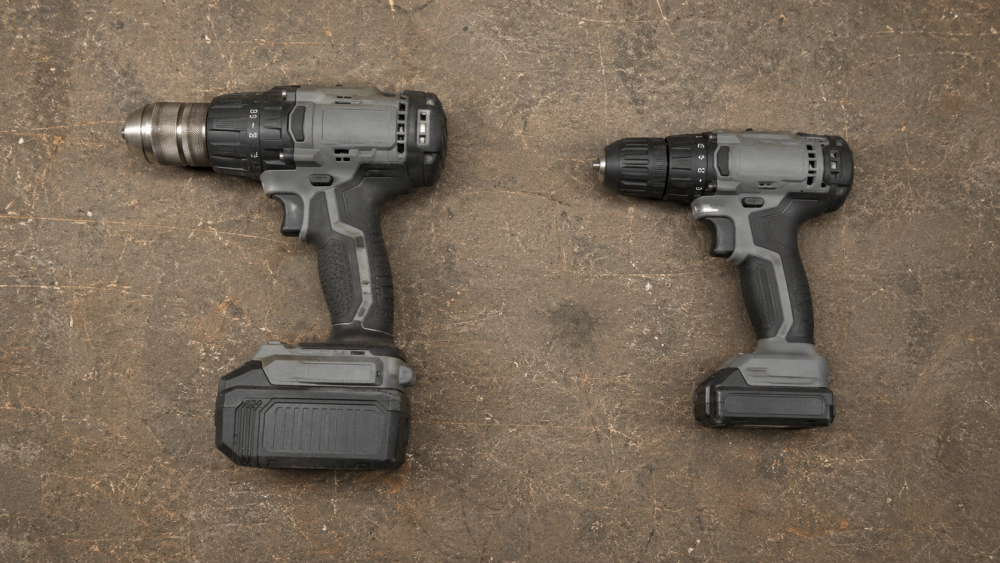
Put your money into the tools you use daily and the ones where accuracy or power matters. That usually means the combi drill and impact driver, the primary saw for your trade, the SDS drill if you’re regularly in masonry, and the dust extractor. Brushless motors are worth paying for on high-use tools — longer runtime per charge, less heat, and no brushes to wear out or replace. Some professional manufacturers offer extended warranties when tools are registered within a specified period, so check the current registration terms before purchasing. The availability of spares and service centres years down the line is worth weighing up too.
2. Where you can save
Occasional-use and specialist tools are a different case. A jigsaw you reach for once a month, a bench grinder, a heat gun, a second-string sander — mid-range kit here is usually fine, and hiring makes sense for anything you’d use a handful of times a year. Reconditioned tools sold directly by the manufacturer, and end-of-line bare units, are a genuine way to stretch a budget without dropping to a DIY duty rating.
3. The false economies
Buying the cheapest version of a tool you use every day is the classic one. So is buying a corded tool to save money and then never using it because there’s no power on site. And the biggest of all: buying tools across four different battery platforms because each one was on offer at the time.
Two practical points on the used market. Second-hand professional tools can be excellent value, but tool theft from vans is common enough that provenance matters — ask for the original receipt, check for ground-off or defaced markings, and be wary of anything priced far below the going rate. And any second-hand corded tool should be inspected properly before it goes near a site.
Sticking to One Battery Ecosystem
Once you own more than three or four cordless tools, the battery platform matters more than the tools themselves.
The reasoning is straightforward. Batteries and chargers are a large share of what you spend on cordless kit, so every tool you buy bare on a platform you already own is dramatically cheaper than the same tool as a kit. One platform also means any battery fits any tool: when a pack dies mid-task, you take one off the drill and carry on rather than hunting for the right charger. Cross-brand adapters exist, but they may affect performance, safety features and warranty coverage. Check the tool and battery manufacturers’ terms before using one.

So choose the platform deliberately, and choose it for the range rather than for one tool. The questions worth asking:
• How wide is the range? Does the platform cover the specialist tools you’re likely to want in three years, not just the ones you need today?
• Is it one voltage or several? Some manufacturers run a single 18V line-up; others split across 12V, 18V and 36V/twin-18V. A 12V sub-compact range is genuinely useful for overhead and cabinet work, but check it shares chargers with the main line.
• What’s battery availability like locally? A platform you can replace on a Saturday morning from a local merchant beats a marginally better one you have to order in.
• How’s the backwards compatibility? The major professional brands have kept the same battery interface for years, which protects the investment you’re making now.
Practically, aim for a spread of pack sizes rather than all-large or all-small: compact packs for drilling and driving where weight on the wrist matters, high-capacity packs for saws, grinders and anything with a sustained draw. Three or four batteries in rotation is a realistic working minimum. Keep them out of the van overnight in hard frost and out of direct sun in summer, charge them before they’re completely flat, and store them at part charge if a tool is going unused for months.
Where a second platform does make sense is at the extremes — a dedicated dust extractor, a mitre saw or a transformer-fed 110V tool on a site that demands it. That’s a considered exception, not the same as drifting into four platforms by accident.
Don’t Overlook the Safety Kit
The tools above create the two site risks that catch tradespeople out over a career: dust and vibration. Neither hurts today, which is exactly why both get ignored.
Cutting, grinding, chasing and drilling masonry all release respirable crystalline silica, which carries a workplace exposure limit of 0.1 mg/m³ averaged over an eight-hour shift — a level that uncontrolled cutting can pass in a matter of minutes. The controls are the same whichever tool you’re holding: eliminate the dust where you can, then water suppression or on-tool extraction, then properly selected, face-fit-tested RPE. That’s why an M-class extractor belongs on the essential list rather than the wish list, with an H-class unit where the task and risk assessment call for one.

Vibration is the other one. Under the Control of Vibration at Work Regulations 2005, hand-arm vibration has a daily exposure action value of 2.5 m/s² A(8) and an exposure limit value of 5 m/s² A(8), and grinders, breakers and SDS drills eat into that allowance quickly. Low-vibration tools, sharp consumables and job rotation all help — blunt discs and worn bits make both the vibration and the dust worse.
Add to that the basics: guards left on, RCD protection on corded tools, PUWER-compliant inspection and maintenance, eye protection, and hearing protection where the noise assessment requires it — needing to raise your voice to speak to someone nearby is a useful warning that noise levels may be hazardous.
Buy Once, Buy Right
A good kit isn’t the most expensive one — it’s the one where the tools you use daily are properly specified, the batteries are interchangeable, and nothing on the van is waiting to fail mid-job. Start with the five tasks you do most, buy professional-grade for those, pick one battery ecosystem and stay in it, and let the specialist tools arrive as the work justifies them.
The tools that keep you working safely for the next thirty years matter as much as the ones that get today’s job finished. Build the kit around both.
Owning the right tools is only part of working safely and professionally on site.
Explore our Health and Safety in Construction Courses to improve knowledge, reduce workplace risks and support safer working practices.