
Sustainable Construction Materials: What to Specify in 2026
Sustainable construction materials have moved from a nice-to-have to a line item on the tender document. Buildings and product uses were provisionally estimated to account for approximately 22% of UK territorial greenhouse gas emissions in 2025. As operational energy standards improve, the embodied carbon associated with construction materials is receiving greater attention. In England, the Future Homes and Buildings Standards were published in March 2026 and generally take effect from March 2027, while the voluntary UK Net Zero Carbon Buildings Standard has introduced measurable embodied carbon criteria. Clients are asking questions about material sourcing that simply weren’t being asked five years ago. This guide covers why sustainability became a client demand, which alternative building materials are worth knowing about, and the skills and certifications that will keep you competitive.
A note on scope: Building Regulations are devolved. The Future Homes and Buildings Standards described in this guide apply to England only. Scotland, Wales and Northern Ireland set their own standards — Scotland through its own Building Standards and associated energy requirements, Wales through its own Part L, and Northern Ireland through its own Technical Booklets. If you work across borders, check the requirements for the nation your project sits in. The material guidance in the rest of this article applies generally, but the regulatory drivers do not.
Why Sustainability Is Now a Client Demand
For years, going green on a build was a choice made by clients who cared about it personally. That has changed, and it has changed for commercial reasons rather than ethical ones. Three separate pressures have converged, and all of them land on the contractor.
The first is regulation. In England, the Future Homes and Buildings Standards were published on 24 March 2026 and generally take effect from 24 March 2027, subject to transitional arrangements, with selected provisions for higher-risk buildings applying from 24 September 2027. New homes built to the standard are expected to produce at least 75% fewer carbon emissions than homes built to the 2013 baseline. Importantly, this is a performance-based standard rather than a prescriptive list of products. Low-carbon heating such as heat pumps or heat networks is expected, and solar panels are expected on the majority of new homes, but alternative compliance routes and exceptions exist, and the right solution depends on the site and the design. The standard targets operational energy rather than materials — but by reducing operational carbon so substantially, it makes emissions from materials a larger share of a building’s remaining lifetime footprint.
The second is contractual. Embodied carbon is not currently a statutory requirement for most housing, but whole-life carbon assessment is increasingly treated as a professional expectation even where nobody is mandating it. The voluntary UK Net Zero Carbon Buildings Standard Version 1, published in March 2026, provides measurable criteria for assessing operational energy, embodied carbon and other net-zero requirements. It is an industry standard — not Building Regulations and not a statutory requirement — but where a main contractor has adopted it or committed to a carbon target, that commitment is typically passed down the supply chain as a specification you have to meet.
The third is financial. Large housebuilders now report material emissions as part of their own Scope 3 figures, which lenders and investors examine closely. Add planning authorities asking for sustainability statements and clients wanting BREEAM or Passivhaus credentials, and the result is straightforward: subcontractors who can evidence what they install and why are better placed to bid for this work.

Alternative Building Materials to Watch in 2026
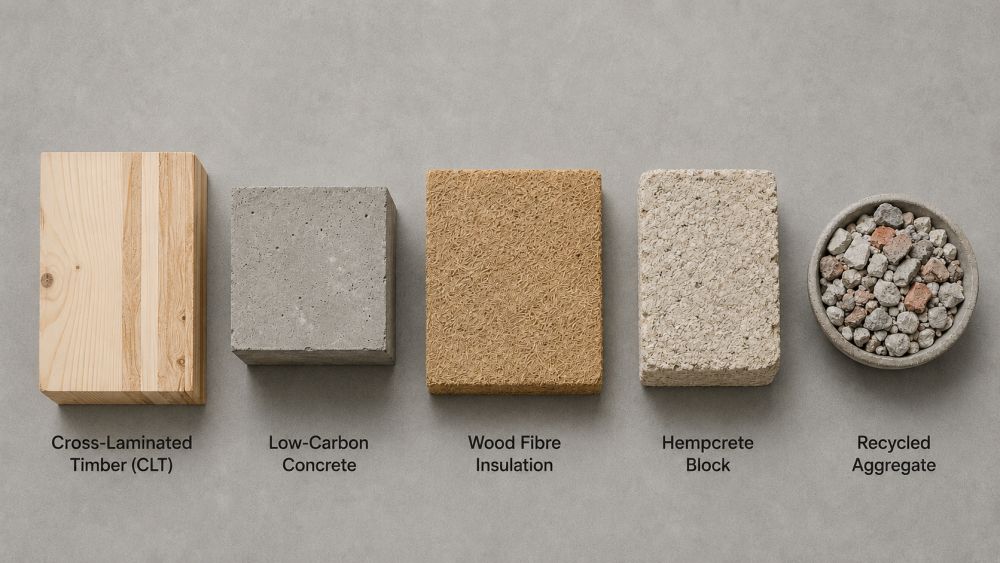
The materials below are not experimental — all are specified on live UK projects, and most can be sourced through mainstream merchants or specialist suppliers, depending on the product and your region. What follows is what each one does, where it fits, and what to watch out for on site.
Cross-laminated timber (CLT) and engineered wood
CLT is made from timber boards glued in layers at right angles to each other, producing structural panels strong enough to substitute for concrete and steel in walls and floor decks. It is increasingly specified on schools, offices and mid-rise housing, alongside glulam beams and LVL, though uptake varies considerably by sector and region. The appeal is that timber stores the carbon absorbed while the tree grew, locking it into the building, while the panels themselves are lighter — which can reduce foundation sizes and transport movements. Panels arrive cut to size, so programmes may shorten and site waste can drop.

Fire and regulatory requirements vary by nation and building type, and this needs specialist input. In England, regulation 7(2) of the Building Regulations restricts combustible materials in and on the external walls of specified buildings over 18 metres, which affects structural timber within the external wall at those heights. Structural timber may be used below that threshold where it is designed safely and complies with the Building Regulations. Separate fire-safety requirements may apply depending on the building type, use and height. Approved Document B has been under review following the Grenfell Tower Inquiry Phase 2 report, so confirm the current position before designing. Requirements differ in Scotland, Wales and Northern Ireland. Any CLT scheme needs a competent structural and fire engineer involved from the outset — it is not a like-for-like substitution. Specify FSC or PEFC certified stock, and pay close attention to moisture protection at connections, because timber that gets wet during the build is a problem you cannot easily undo.
Low-carbon concrete
Cement production, which provides the main binder in concrete, accounts for around 7% of global carbon emissions, which makes it a major target for improvement. Low-carbon mixes replace a share of Portland cement with ground granulated blast-furnace slag (GGBS), fly ash or ternary cements, and can reduce embodied emissions against a standard mix depending on the specification and replacement level. BS 8500-1:2023 includes provisions for lower-carbon concrete compositions and greater use of supplementary cementitious materials, so these mixes can be specified through the standard route rather than as a special order. The practical catch is curing: many low-carbon mixes gain strength more slowly, so striking times and programme allowances may need adjusting rather than assuming your usual figures still apply. Confirm requirements with the supplier and the structural engineer for each pour.
Natural and bio-based insulation
Sheep’s wool, wood fibre, hemp and cellulose insulation are the established natural options. Thermal performance can be comparable to mineral alternatives depending on the product and specification, and some products may perform better in breathable constructions where moisture management matters — check the manufacturer’s technical data and the specifier’s build-up rather than assuming. Wood fibre boards have become a common choice for retrofit on solid-wall properties. Expect a higher material cost and thicker build-ups for the same performance, which needs designing in early rather than discovered at first fix.
Safety note: some natural insulation products may be more comfortable to handle than conventional alternatives. However, installers must still follow the product safety data sheet, the COSHH assessment and the manufacturer’s requirements for dust control, PPE and respiratory protection. HSE guidance confirms that construction dust and wood dust must be controlled, and that respiratory protective equipment is required for many cutting and sanding activities. Treat natural materials as you would any other — assess the task, control the dust at source, and use the specified RPE.
Hempcrete and other bio-based options
Hempcrete mixes hemp shiv with a lime binder to make a non-structural walling and insulation material that absorbs carbon as it cures. It suits low-rise residential and self-build work, needs a separate structural frame, and requires a genuinely long drying time before finishes go on. Bio-based composites and bamboo products sit in the same bracket — promising, increasingly available, but currently better suited to specific applications than general use.
Recycled aggregates and reclaimed materials
The cheapest carbon saving is often the one nobody markets. Recycled aggregates in non-structural work, reclaimed brick and reused steel sections can cut both embodied carbon and material cost, and they generally sit closer to familiar working practice than newer products — though reclaimed materials still require inspection, grading and, for structural reuse, competent verification of their properties. On refurbishment projects, retaining and repairing existing structure often has a lower carbon impact than replacing it, though this should be confirmed by a whole-life carbon assessment for the specific project rather than assumed.


Choosing Sustainable Construction Materials: Skills and Certifications Worth Having
Understanding innovative sustainable building products is one thing; being able to prove it to a client or main contractor is another. A handful of qualifications and habits do most of the work here.
• Get the basics evidenced. A relevant CSCS card is commonly required by principal contractors and major housebuilders, although holding one is not a statutory requirement and does not automatically guarantee access to a site. Clients and principal contractors may also require evidence of current health and safety training relevant to the role.
• Learn to read an EPD. An Environmental Product Declaration is a standard, independently verified document showing a product’s environmental impact, including carbon. Being able to interpret one — and spot a supplier claim that isn’t backed by one — is genuinely useful when specifications are being argued over.
• Consider retrofit qualifications. PAS 2035 roles such as Retrofit Assessor and Retrofit Coordinator are specified on many funded retrofit schemes, and holding them can open up work that is otherwise closed to you, subject to the requirements of the particular scheme.
• Look at Passivhaus and low-energy training. Passivhaus Tradesperson certification and airtightness training are increasingly specified on higher-performance projects, and the detailing skills transfer to everyday work.
• Get manufacturer training on new products. CLT, timber-frame systems and natural insulation all have installation requirements specific to the product. Most manufacturers run free or low-cost courses, and evidence of correct installation can support your position if a warranty or defect claim arises — though warranty terms vary by manufacturer and should be checked.
• Keep records of what you install. Product certificates, batch details and photographs of build-ups support handover documentation and make you easier to work with on carbon-assessed projects.
None of this requires abandoning your trade and retraining. The contractors doing well are largely the ones who added one or two credentials on top of existing skills and can now answer questions about materials with confidence rather than guesswork.
Making the Switch on Your Next Project
You don’t need to overhaul everything at once. Substituting a low-carbon concrete mix, using recycled aggregate in non-structural work, or switching to natural insulation on one job gives you real experience without putting a programme at risk.
• Ask suppliers for EPDs on the products you use most often and compare them
• Discuss a lower-carbon concrete mix with your supplier and engineer, and allow for curing times
• Trial natural insulation on a single plot or retrofit before committing across a site
• Specify FSC or PEFC certified timber as standard, not by exception
• Use recycled aggregates and reclaimed materials where structural duty and verification allow
• Check which national Building Regulations apply to each project before specifying
• Book one relevant course this year and add it to your tender documents

The direction of travel is clear enough that waiting carries its own risk. Regulation is tightening, clients are asking harder questions, and the supply chain has already responded. Builders who learn these materials now will be quoting on work in two years that others are still reading up on.
Working with new materials safely is part of delivering a professional, compliant job. Explore our construction health and safety training courses to build knowledge, reduce site risk and support safer, more sustainable working practices.