
AI and Predictive Analytics in Construction Accident Prevention
Construction remains the most dangerous industry in Great Britain by absolute numbers. In the HSE's 2024/25 published figures, 124 workers were killed in work-related accidents across Great Britain, with construction accounting for 35 deaths — the highest number of any sector. The HSE’s provisional figures for 2025/26 show 126 worker deaths, with falls from height again the leading cause of fatal injury. Falls from height remain one of the biggest risks in construction and continue to be the leading cause of workplace fatal injuries across Great Britain [internal link: working at height blog/course]. Add tens of thousands of non-fatal injuries every year, and the human and financial cost is enormous.
Here's the uncomfortable truth behind those numbers: almost none of these incidents are truly random. Accidents follow patterns. They cluster around certain trades, certain times of day, certain weather conditions, certain stages of a project, and certain warning signs — near misses, failed inspections, overdue training, rushed schedules. The problem has never been a lack of warning signs. The problem is that no human being can watch an entire site, read every inspection record, and connect every dot in real time.
That's exactly what artificial intelligence and predictive analytics are now doing. Instead of investigating accidents after they happen, AI systems analyse site data continuously and flag where the next incident is most likely to occur — sometimes days or weeks in advance. In this guide, we'll explain what predictive analytics means in construction safety, how the technology actually works, what it can and can't do, and why trained, competent workers remain the foundation that no algorithm can replace.
What Is Predictive Analytics in Construction Safety?
Predictive analytics is the use of historical and real-time data, combined with machine learning algorithms, to forecast future events — in this case, workplace accidents. Rather than asking "what went wrong?" after an incident (reactive safety), predictive systems ask "what is about to go wrong?" (proactive safety).
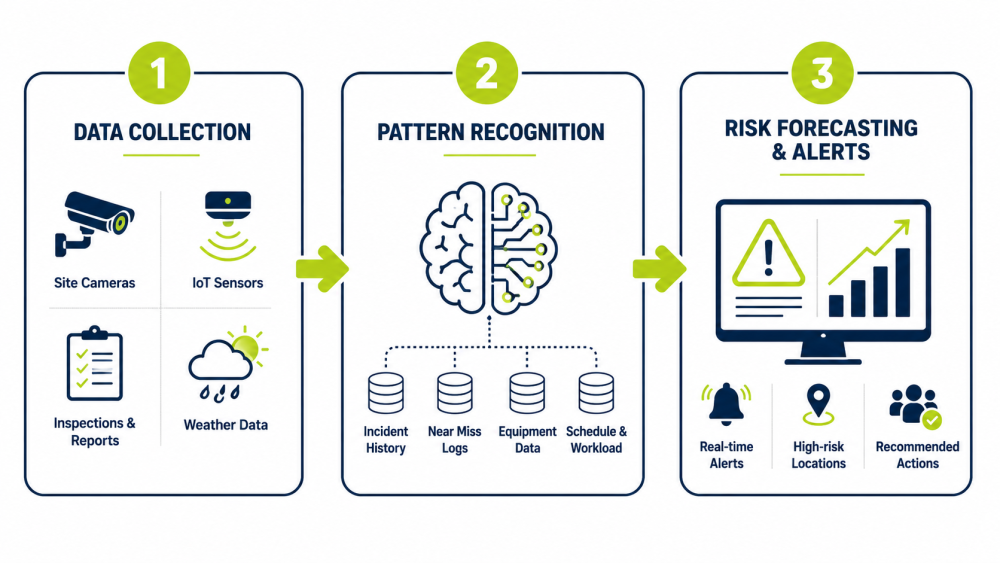
A predictive safety system typically works in three stages:
• Data collection — the system gathers information from incident reports, near-miss logs, site inspections, worker check-ins, equipment sensors, weather feeds, project schedules, and CCTV or camera footage.
• Pattern recognition — machine learning models analyse this data against thousands of past incidents to identify the combinations of conditions that historically precede accidents.
• Risk forecasting and alerts — the system flags high-risk activities, locations, teams, or time windows, and recommends interventions before anyone gets hurt.
Published industry analysis suggests that machine learning models trained on digital safety management data can identify accident patterns with up to 85% accuracy (The Data Scientist, 2025), while Oracle reports that customers using its predictive safety tool have reduced incident rates by up to 50% in the first year. (Oracle Construction and Engineering, 2026). Results will vary from firm to firm, but the direction of travel is clear. Construction is also unusually well suited to this approach: unlike finance or retail, where risk patterns emerge in seconds, construction risk builds over days and weeks — which leaves a genuine window for someone to step in and prevent the incident.

How AI Predicts Accidents Before They Happen
"AI" in construction safety isn't one single technology. It's a family of tools, each watching a different part of the site. The most important ones are:
1. Computer Vision and Smart Cameras
AI-powered cameras monitor live site footage and automatically detect unsafe conditions and behaviours: workers without hard hats or harnesses, people entering exclusion zones, vehicles operating too close to pedestrians, or materials stacked dangerously. Instead of a supervisor spotting one violation an hour, computer vision watches every camera, all day, and alerts the site team in real time.
2. Wearables and IoT Sensors
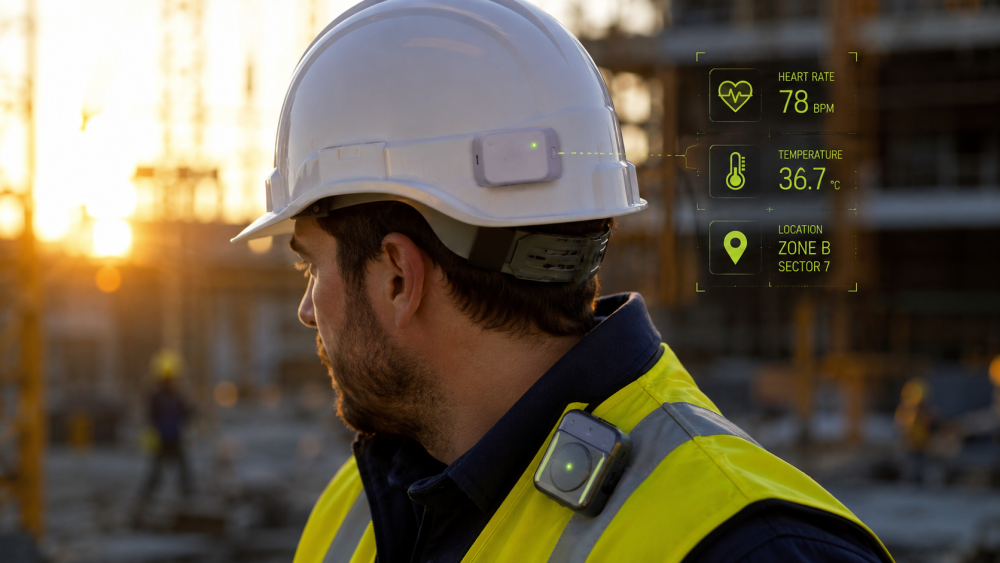
Smart helmets, vests, and badges can track worker location, detect falls, monitor fatigue and heat stress, and vibrate to warn workers approaching moving plant. Sensors on equipment monitor vibration, load, and usage patterns to predict mechanical failures before they cause an incident. Every one of these devices is also a data source feeding the predictive model.

3. Machine Learning on Historical Incident Data
This is the engine room of predictive safety. Algorithms trained on thousands of past incidents, near misses, inspection results, and site conditions learn which combinations of factors tend to precede accidents — for example, a specific trade working at height, behind schedule, in wet weather, with a spike in near-miss reports the previous week. When the model sees that pattern forming again, it raises the alarm.
4. Natural Language Processing (NLP)
Much of a site's safety intelligence is buried in free-text documents: incident narratives, inspection comments, toolbox talk records, permit notes. NLP tools read this text at scale and extract trends a human reviewer would never have time to find — such as the same hazard being mentioned in passing across dozens of reports before it finally causes an injury.
5. Predictive Scheduling and Risk Scoring
Some platforms combine live project schedules, active trades, workloads, and weather forecasts to score the risk of each upcoming activity. A site manager can open a dashboard on Monday morning and see which tasks this week carry the highest predicted risk — and assign extra supervision, briefings, or controls accordingly.
What This Looks Like in Practice
Imagine a groundworks package running two weeks behind schedule. The predictive system notices: overtime hours are climbing, near-miss reports involving excavation plant have doubled, two operatives have refresher training that expired last month, and heavy rain is forecast for Thursday. Individually, each of these facts might pass unnoticed. Together, they match a pattern that has preceded serious incidents on hundreds of past projects.
The system flags Thursday's excavation work as high risk and recommends specific actions: a pre-task briefing, refreshed training sign-off, additional exclusion zone monitoring, or rescheduling the highest-risk lift. The accident that "would have" happened on Thursday never makes it into any statistics — which is exactly the point.
The Benefits of AI-Driven Accident Prevention
• Fewer injuries and fatalities — the core benefit. Predictive tools catch developing risks that human oversight misses, and early adopters report significant reductions in incident rates.
• From reactive to proactive — safety teams stop firefighting after incidents and start preventing them, changing the entire culture of the site.
• Better use of limited safety resources — instead of spreading supervision evenly, managers concentrate attention where the data says risk is highest.
• Lower costs — fewer incidents mean less downtime, lower insurance premiums, reduced workers' compensation claims, and protection from HSE fines and prosecution.
• Stronger compliance evidence — continuous monitoring and documented risk forecasting demonstrate to regulators that risk is being actively managed, supporting duties under the Health and Safety at Work etc. Act 1974 and CDM Regulations 2015.
• Reduced human error in monitoring — algorithms don't get tired, distracted, or complacent at 4pm on a Friday.
The Limitations — What AI Can't Do
Predictive analytics is powerful, but it is not magic, and any contractor considering it should understand the limits:
• It's only as good as the data. Sites that under-report near misses or keep patchy inspection records will get weak predictions. "Garbage in, garbage out" applies with full force.
• A prediction is not a prevention. An alert on a dashboard saves no one unless a competent person acts on it. The technology supports decisions; it doesn't make them.
• Privacy and trust matter. Wearables and cameras that track workers raise legitimate concerns. Firms need transparent policies on what is monitored, why, and how data is used — or workers will (rightly) push back.
• Cost and integration. Smaller contractors may find full platforms expensive, though entry-level tools such as smart cameras and digital near-miss reporting are increasingly affordable.
• Algorithms can inherit bias. If historical data reflects past blind spots, predictions can repeat them. Human review of AI recommendations remains essential.
Is There a Legal Requirement to Use AI in Site Safety?
No UK law currently requires construction firms to use AI or predictive analytics. However, the legal duties that these tools support are very real. The Health and Safety at Work etc. Act 1974, the Management of Health and Safety at Work Regulations 1999, and the CDM Regulations 2015 all require employers to assess risks, plan work safely, and take reasonably practicable steps to protect workers.
As predictive technology becomes cheaper and more widespread, the definition of "reasonably practicable" evolves with it. A tool that is exotic today can become industry standard tomorrow — and firms that ignore widely available risk-reduction technology may find that harder to defend after a serious incident. What the HSE and the courts will always examine is whether risk was properly assessed, workers were competent and trained, and sensible precautions were in place.

The Human Element: Why Training Still Comes First
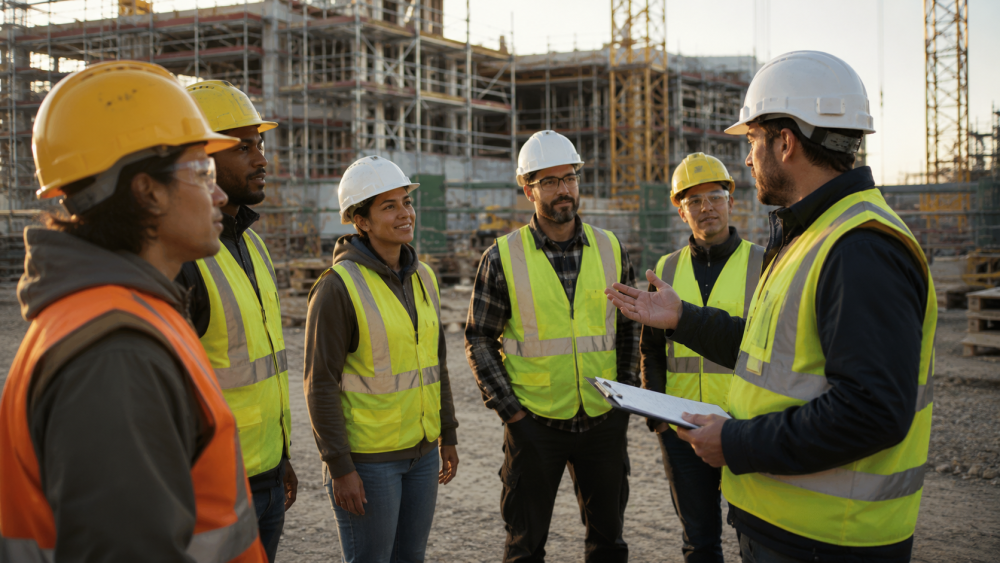
Here is the point too many technology discussions miss: AI does not replace competent workers — it depends on them. An algorithm can predict that Thursday's excavation carries elevated risk. It cannot brief the gang, check the harness, set the exclusion zone, or make the split-second decision to stop work. That takes trained people.
In fact, predictive analytics makes training more important, not less. Workers and supervisors need to understand what the alerts mean, trust the system enough to act on it, and hold the underlying safety knowledge — working at height, manual handling [internal link: manual handling blog/course], plant safety, and risk assessment [internal link: risk assessment blog] — that turns a warning into a prevention. That foundation starts with accredited training such as a Level 1 Health & Safety in a Construction Environment course [internal link: Level 1 Health & Safety course] and, for site-based workers, the CSCS Green Card [internal link: CSCS Green Card full bundle] backed by CITB test preparation [internal link: CITB mock test page]. The safest sites of the next decade will be the ones that combine smart technology with a properly trained workforce. Neither works alone.
Common Myths About AI in Construction Safety
• "AI will replace safety officers." It won't. It removes the impossible burden of watching everything at once, freeing safety professionals to do the human work — coaching, investigating, intervening — that no algorithm can.
• "It's only for huge contractors." Entry costs are falling fast. Smart cameras, digital reporting apps, and off-the-shelf predictive platforms are within reach of mid-sized and even small firms.
• "If the AI doesn't flag it, it must be safe." Dangerous thinking. Predictive systems reduce risk; they don't eliminate it. Standard controls, inspections, and competence requirements still apply in full.
• "Cameras and wearables are just surveillance." Used properly, the data is about conditions and risk patterns, not disciplining individuals. Firms that are transparent about this see far better worker buy-in.
• "Predictive safety is unproven hype." Peer-reviewed studies in journals such as Automation in Construction, alongside published industry results, report meaningful improvements in hazard identification and incident rates. Outcomes depend on data quality and implementation, but the technology is well past the experimental stage.
Summary
Construction accidents are not random. They follow patterns — and for the first time, technology exists that can read those patterns faster and more completely than any human ever could. AI and predictive analytics are shifting construction safety from reactive investigation to genuine prevention: spotting the conditions that precede accidents and giving site teams the time to intervene.
But the technology is an amplifier, not a substitute. A predictive alert is worthless without a competent supervisor to act on it, and a smart camera can't fix a workforce that hasn't been trained in the basics of working safely. The future of construction safety belongs to firms that invest in both: intelligent systems that see the risk coming, and skilled, trained people ready to stop it. Get that combination right, and the accident statistics that have haunted this industry for decades will finally start to look very different.
Frequently Asked Questions
What is predictive analytics in construction safety?
It's the use of AI and machine learning to analyse historical and real-time site data — incidents, near misses, inspections, sensor readings, schedules, weather — to forecast where and when accidents are most likely to happen, so they can be prevented before they occur.
How accurate is AI at predicting construction accidents?
Some industry analysis suggests machine learning models can identify accident-risk patterns with high accuracy, although results depend heavily on data quality and project conditions.
What data does a predictive safety system use?
Typical inputs include incident and near-miss reports, site inspection records, worker check-ins and training records, IoT sensor and wearable data, camera footage, project schedules, and weather conditions.
Is AI safety monitoring legal in the UK?
Yes, provided it complies with UK GDPR and employment law. In line with ICO guidance on monitoring workers, employers should document the purpose of monitoring, minimise the personal data collected, inform workers clearly about what is monitored and why, consult them before deployment, and complete a Data Protection Impact Assessment where monitoring is likely to create a high risk to individuals.
Does using AI mean workers need less safety training?
No — the opposite. Predictive systems generate warnings; only trained, competent workers can act on them. UK law still requires anyone carrying out construction work to be competent for their role, and technology does not change that duty.
Can small construction firms afford predictive safety technology?
Increasingly, yes. While enterprise platforms carry enterprise price tags, affordable entry points — AI-enabled cameras, digital near-miss reporting apps, and subscription-based analytics tools — are now accessible to smaller contractors.