
Protecting Hearing on Construction Sites: UK Noise Regulations Guide 2026
Construction is loud. Between angle grinders, breakers, pile drivers, and the constant hum of heavy plant, a typical building site is one of the noisiest workplaces in the UK. Most workers barely think about it — until the day they realise they're turning the television up louder than they used to, or there's a constant ringing in their ears that never quite goes away. That damage is permanent. Noise-induced hearing loss is one of the most common occupational illnesses in the UK, and the cruel part is that it builds up silently over years. By the time you notice it, it's already too late to undo. The good news is that it is almost entirely preventable — and the law requires your employer to help prevent it.
In this guide we'll explain how building site noise damages your hearing, what the UK regulations actually require, how to think about noise control on site, where hearing protection and noise cancellation fit in, and the practical steps every worker and employer can take to protect hearing for the long term.
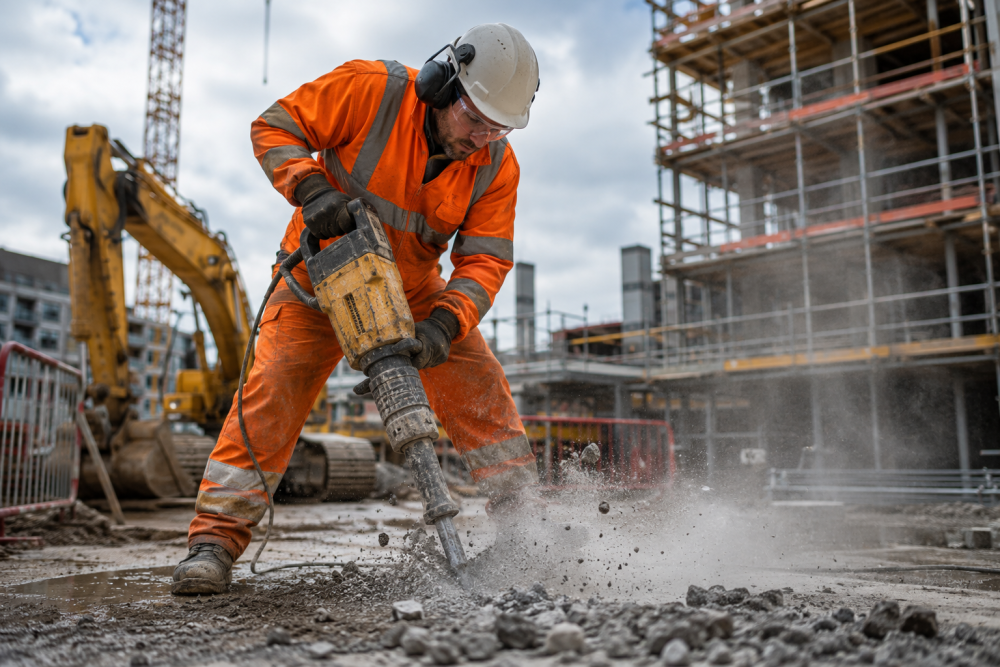

Why Protecting Hearing on Site Matters
Protecting hearing is one of the most overlooked parts of site safety, precisely because the damage is invisible and painless. Unlike a fall or a cut, hearing loss gives you no immediate signal that anything is wrong. It creeps up over months and years until, one day, you realise you can no longer follow a conversation in a busy room or you've developed a permanent ringing in your ears.
For a construction worker, hearing isn't just about comfort — it's a safety-critical sense. You rely on it to hear reversing alarms, shouted warnings, and the change in pitch of a tool that's about to fail. Protecting hearing keeps you safe on site today and keeps your quality of life intact for decades after you've hung up your boots. That's why it deserves the same attention as any other hazard on site.
How Loud Is a Typical Building Site?
Noise is measured in decibels (dB). The decibel scale isn't linear — every 3 dB increase roughly doubles the sound energy reaching your ear. So a jump from 85 dB to 91 dB isn't a small change; it's around four times the noise exposure.
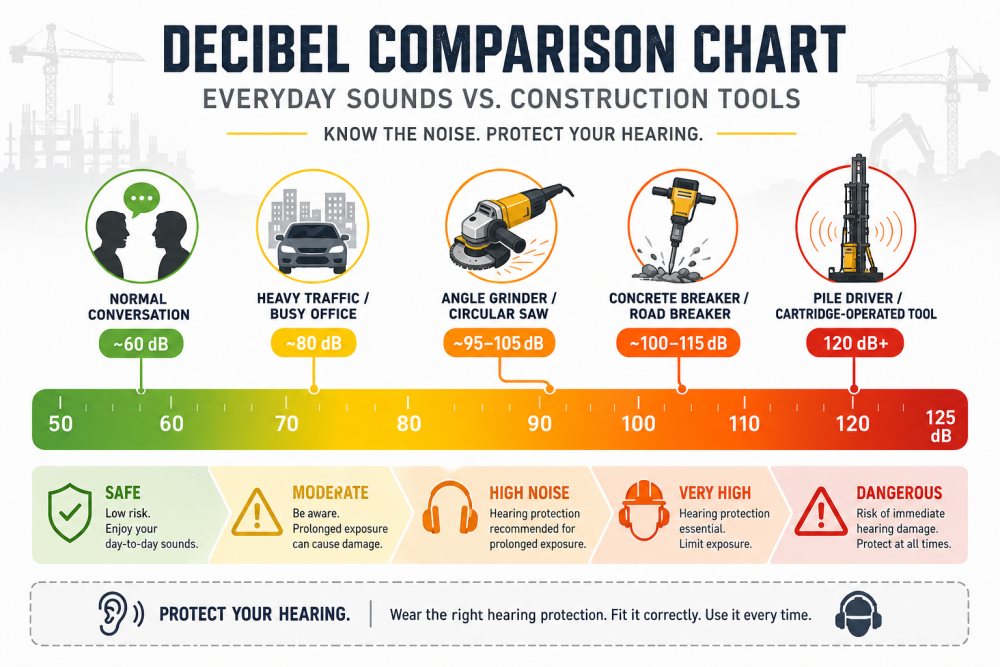
To put construction work noise in context, here are some typical levels you'll come across on site:
• Normal conversation: around 60 dB — completely safe.
• Heavy traffic or a busy office: around 80 dB.
• Angle grinder or circular saw: around 95–105 dB.
• Concrete breaker / road breaker: around 100–115 dB.
• Pile driver or cartridge-operated tool: 120 dB and above — capable of causing instant damage.
As a simple rule of thumb: if you have to raise your voice to be understood by someone standing two metres away, building site noise levels are likely high enough to damage hearing over time. If you have to shout at someone an arm's length away, the noise is dangerously loud.

How Does Construction Work Noise Damage Your Hearing?
Inside your inner ear are thousands of tiny hair cells that convert sound vibrations into signals your brain understands. Loud noise physically damages these hair cells — and unlike skin or bone, they do not grow back. Once they're gone, they're gone for good.
There are two ways building site noise causes harm. The first is sudden, extreme noise — like an explosive bang or a cartridge tool firing close to your ear — which can rupture or destroy hair cells instantly. The second, and far more common, is gradual damage from being exposed to high noise levels day after day, year after year.
The two main warning signs are tinnitus (a ringing, buzzing, or hissing in the ears) and noise-induced hearing loss (difficulty hearing speech, especially in noisy rooms). Many workers first notice they're struggling to follow conversations in the pub or asking people to repeat themselves. By that stage, permanent damage has already been done.
What Do UK Regulations Say About Protecting Hearing?
The key law is the Control of Noise at Work Regulations 2005. It places a legal duty on employers to protect workers from the harmful effects of noise. The regulations work around two key daily noise levels, called action values.
Lower exposure action value — 80 dB(A), daily or weekly personal noise exposure: At this level, the employer must assess the risk, provide information and training, and make hearing protection available to workers who ask for it.
Upper exposure action value — 85 dB(A), daily or weekly personal noise exposure: At this level, the employer must take active steps to reduce noise through noise control measures, mark out hearing protection zones, and ensure hearing protection is worn — not just offered.
Exposure limit value — 87 dB(A)your emo: This is the absolute maximum allowed at the ear, taking hearing protection into account. It must never be exceeded.
Alongside these, the regulations also set peak sound pressure values for sudden, very loud noises like cartridge tools or impacts: 135 dB(C) at the lower action value, 137 dB(C) at the upper action value, and 140 dB(C) as the exposure limit value.
Employers also have a duty to provide health surveillance — regular hearing checks — for workers regularly exposed above the upper action value. As a worker, you have the right to this protection, and the right to be trained on how to use it properly. If your employer isn't meeting these duties, they're breaking the law.

Noise Control: How to Reduce Noise at the Source
UK law is clear that hearing protection should be the last line of defence, not the first. The most effective approach to noise control is to reduce the noise before it ever reaches the worker's ear. Health and safety professionals follow a simple order of priority:
• Eliminate or substitute: Can a quieter method or tool do the same job? For example, using a hydraulic block splitter instead of a cut-off saw, or bolting instead of riveting.
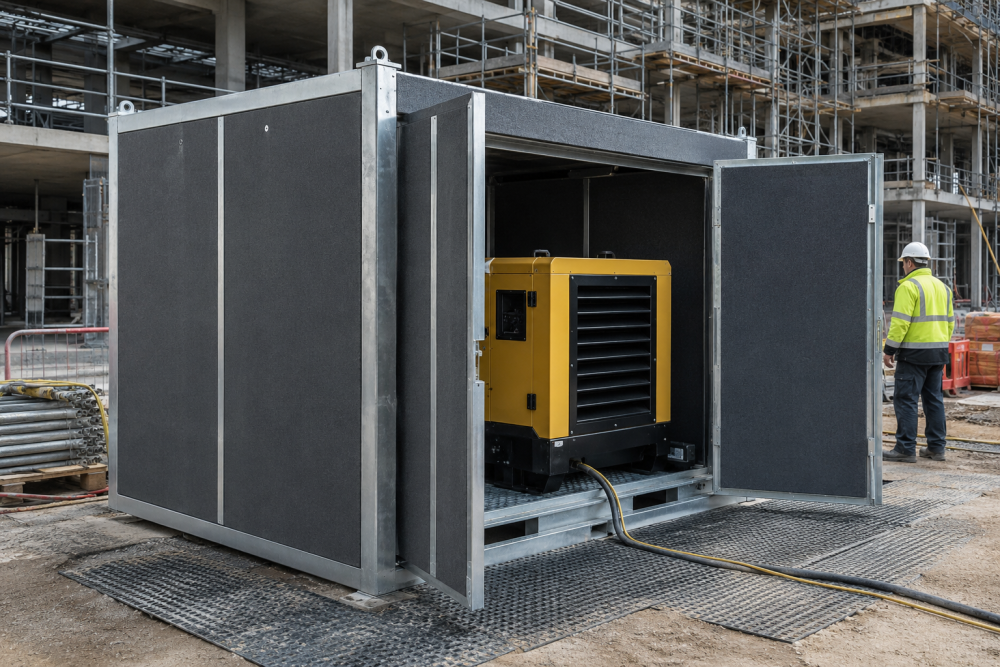
• Engineering controls: Fit silencers, dampers, and acoustic enclosures to machinery. Maintain tools well — worn or poorly maintained equipment is often far louder.
• Distance and layout: Position noisy plant away from where people work. Use barriers and screens to block the path of the noise.
• Limit exposure time: Rotate workers through noisy tasks so no one person absorbs the full daily dose, and schedule the loudest jobs when fewer people are nearby.
• Hearing protection: Only after the above have been applied should ear defenders and ear plugs be relied on to make up the difference.
This same principle applies to industrial noise control in factories, workshops, and manufacturing units, where the noise sources are usually fixed machines rather than handheld tools. Because the equipment stays in one place, more permanent engineering solutions become practical: machines can be sealed inside acoustic enclosures or hoods, mounted on anti-vibration pads to stop noise travelling through the floor, fitted with silencers on exhausts and air outlets, and separated from work areas by sound-absorbing partitions. A well-planned industrial noise control programme treats noise reduction as part of the building and machinery design, not just something workers wear protection against. The result is lower noise for everyone in the space, all of the time, rather than relying on each individual to protect themselves.

Choosing the Right Hearing Protection
When noise can't be reduced enough at the source, hearing protection fills the gap. There are two main types, and the right choice depends on the task, the noise level, and what's comfortable enough to actually be worn all day.
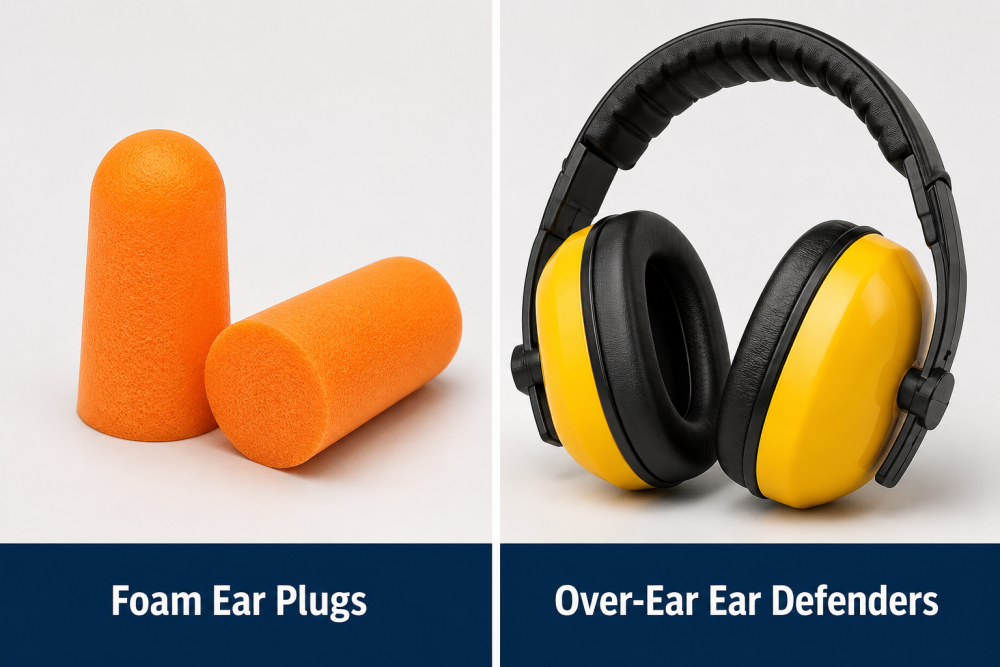
Ear plugs (foam, silicone, or custom-moulded) sit inside the ear canal. They're cheap, light, and good for steady, all-day wear in moderate noise — but only if they're inserted correctly. A badly fitted plug offers almost no protection.
Ear defenders (ear muffs) sit over the whole ear. They're easy to fit correctly, easy to take on and off, and better suited to very loud, intermittent tasks like breaking or grinding. They can be worn with — but not instead of — plugs in extreme noise.
Every product carries an SNR (Single Number Rating) showing roughly how many decibels it cuts. The trap to avoid is over-protection: blocking out too much noise can leave a worker unable to hear warnings, reversing alarms, or instructions, which creates a different safety risk. The aim is to bring the noise at the ear down to a safe level — typically below 85 dB — not to silence everything.
Important: hearing protection only works if it's worn correctly, 100% of the time it's needed. Taking ear defenders off “just for a minute” near a breaker undoes much of the protection for that whole shift.

Does Noise Cancellation Help on a Building Site?
Noise cancellation technology has become hugely popular in headphones, and many workers ask whether it can protect their hearing on site. It's worth understanding what it does and doesn't do.
Active noise cancellation works by detecting incoming sound and generating an opposite sound wave to cancel it out. It's very good at reducing steady, low-frequency hums — like the drone of an engine, generator, or aircraft cabin. However, it's far less effective against the sudden, sharp, high-energy noise of construction work, such as a hammer strike or a grinder, which is exactly the kind of noise that damages hearing most.
The key safety message: consumer noise-cancelling headphones are not certified hearing protection (PPE) and should never be used in place of proper ear defenders or plugs on site. Playing music through them can also mask important warning sounds. Some specialist products combine genuine PPE-rated hearing protection with noise cancellation and built-in communication — these are the only kind suitable for work, and only if they carry the correct safety rating.
Practical Steps for Workers and Employers
Protecting hearing on site comes down to a handful of consistent habits. For workers:
• Wear the hearing protection provided whenever you're in a hearing protection zone — every time, not just when it's convenient.
• Learn how to fit ear plugs and defenders correctly, and replace damaged or worn protection.
• Take part in hearing checks (health surveillance) offered by your employer.
• Speak up if a task seems dangerously loud or if the right protection isn't available.
For employers:
• Carry out a noise risk assessment and measure exposure where it may exceed the action values.
• Reduce noise at the source through substitution, engineering controls, and good maintenance before relying on PPE.
• Mark hearing protection zones clearly and supply suitable, well-maintained protection.
• Provide information, instruction, and training so workers understand the risks and how to protect themselves.
• Arrange health surveillance for workers regularly exposed above 85 dB, and keep records.
Summary
Noise-induced hearing loss is permanent, but it is also almost completely preventable. Building site noise and construction work noise routinely reach levels capable of damaging hearing within minutes, yet the harm is so gradual that most workers don't notice it until it's irreversible.
The law puts the responsibility on employers to control that noise — first by reducing it at the source through proper noise control, and only then by providing hearing protection. While noise cancellation has its uses, it is not a substitute for certified PPE on site. The single most important thing any worker can do is wear the right protection, correctly, every single time it's needed.
Protecting your hearing isn't just a legal box to tick. It's what lets you still hear your family, your colleagues, and the world around you decades from now.
Frequently Asked Questions
At what noise level do I legally need hearing protection?
Under the Control of Noise at Work Regulations 2005, your employer must make hearing protection available at 80 dB(A) daily or weekly personal noise exposure, and must ensure it is worn at 85 dB(A).The absolute limit at the ear is 87 dB. As a rough guide, if you have to shout to be heard by someone an arm's length away, the noise is likely above the level where protection is needed.
How loud is a typical building site?
It varies by task, but common construction work noise sits between 95 and 115 dB — angle grinders and circular saws around 95–105 dB, and concrete breakers around 100–115 dB. These levels are well above the point at which hearing damage can occur, which is why hearing protection zones are required on most sites.
Can hearing loss from noise be reversed?
No. Noise-induced hearing loss is permanent. The tiny hair cells in the inner ear that are damaged by loud noise do not grow back. This is why prevention — through noise control and hearing protection — is the only effective approach.
What's the difference between ear plugs and ear defenders?
Ear plugs sit inside the ear canal and are light and good for all-day wear in moderate noise. Ear defenders (ear muffs) sit over the whole ear, are easier to fit correctly, and suit very loud or intermittent tasks. In extreme noise, both can be worn together. The best choice is the one that fits well and is comfortable enough to be worn the whole time.
Can I use noise-cancelling headphones for hearing protection on site?
No. Consumer noise-cancelling headphones are not certified hearing protection (PPE). Noise cancellation works best on steady, low-frequency hums and is far less effective against the sudden, sharp noise of construction tools that causes the most damage. Playing music can also mask important warning sounds. Only PPE-rated products carrying the correct safety rating should be used on site.
What is tinnitus and is it serious?
Tinnitus is a ringing, buzzing, or hissing sound in the ears with no external source. It's often one of the first warning signs of noise damage. It can be temporary after a single loud exposure, but repeated exposure can make it permanent. If you experience ongoing tinnitus, speak to your employer and your GP.
What is a hearing protection zone?
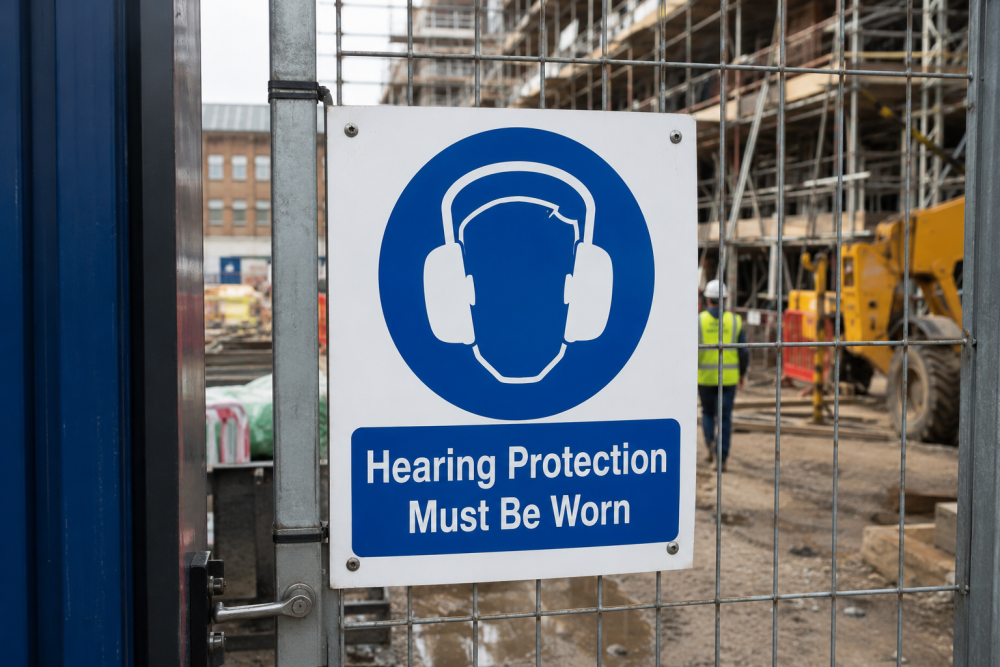
It's an area marked with mandatory signage where noise levels reach or exceed 85 dB and hearing protection must be worn at all times. Employers are legally required to identify and mark these zones and to make sure protection is worn within them.
What is health surveillance for noise?
It's a programme of regular hearing checks (audiometry) that employers must provide for workers who are regularly exposed above the upper action value of 85 dB. It helps catch early signs of hearing damage before they become severe, and the results must be recorded and acted upon.
Whose responsibility is it to protect my hearing at work?
Primarily your employer's. They must assess and control noise, reduce it at the source where possible, provide suitable hearing protection, mark hearing protection zones, train workers, and arrange health surveillance. As a worker, you're responsible for using the protection and controls provided correctly.
Does industrial noise control work differently from a building site?
The principles are the same, but in factories and workshops fixed machinery makes engineering controls more practical — equipment can be enclosed in acoustic hoods, isolated on anti-vibration mounts, or fitted with silencers. On a building site, controls focus more on quieter methods, barriers, distance, and limiting how long each worker is exposed.