
COSHH Awareness: What UK Employers Need to Know in 2026
Hazardous substances continue to cause occupational asthma, dermatitis, lung disease, cancer and other serious health conditions across British workplaces. Most of these cases are preventable, and that is exactly what COSHH exists to stop.
In Great Britain, COSHH refers to the Control of Substances Hazardous to Health Regulations 2002, as amended. Northern Ireland has equivalent requirements under the Control of Substances Hazardous to Health Regulations (Northern Ireland) 2003. Together they place clear legal duties on employers to protect anyone who could be exposed to hazardous substances at work.
This short guide explains COSHH in plain English: what it covers, how to read COSHH symbols, how to carry out a COSHH risk assessment, and why COSHH awareness matters for effective COSHH health and safety management in 2026.

What Is COSHH and Who Does It Apply To?
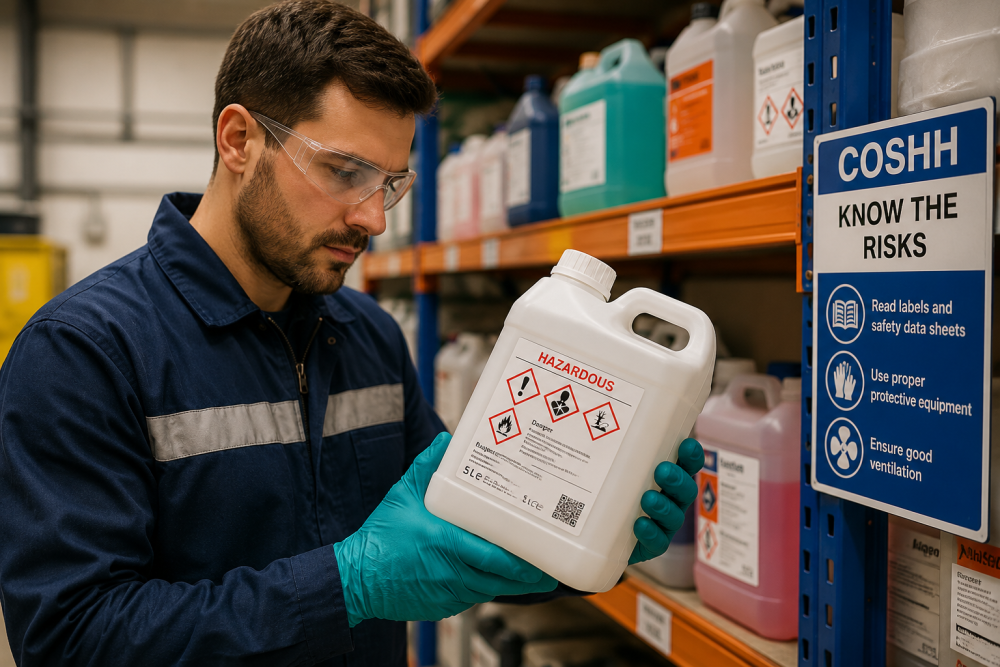
COSHH is the law that requires employers to control substances that are hazardous to health. In practice, that means identifying what could harm your workers, deciding how to prevent or reduce exposure, and putting the right controls in place. Effective COSHH health and safety management starts with identifying harmful substances and controlling exposure before anyone is put at risk.
COSHH can apply across almost every industry — from factories, farms, and construction sites to salons, cleaning firms, laboratories, and offices. Where work uses, produces or generates substances hazardous to health, the employer must determine and comply with the relevant COSHH requirements.
Important: COSHH does not cover asbestos, lead, or radioactive materials — these have their own separate regulations. COSHH applies to most other substances hazardous to health, although additional legislation, such as DSEAR, environmental or transport rules, may also apply depending on the substance and the risks involved.


What Substances Does COSHH Cover?
Many people assume COSHH is only about chemicals in bottles. In reality it covers a far wider range of hazards, including:
• Chemicals — cleaning products, solvents, paints, adhesives, and acids.
• Fumes, gases and vapours — welding fume, exhaust gases, and solvent vapours.
• Dusts — wood dust, flour, silica, and cement dust.
• Mists — from spraying, paint, or metalworking fluids.
• Biological agents — bacteria and other micro-organisms in healthcare, farming, and waste work.

A hazard label, a workplace exposure limit, or a harmful dust, fume, vapour, mist, gas or biological agent may all indicate that a COSHH assessment is required. Importantly, some of the most damaging substances — such as welding fume or silica dust — are created by a work process and carry no supplier label at all. Employers must therefore assess the actual health risks created by the work rather than relying only on the product label.
Understanding COSHH Symbols
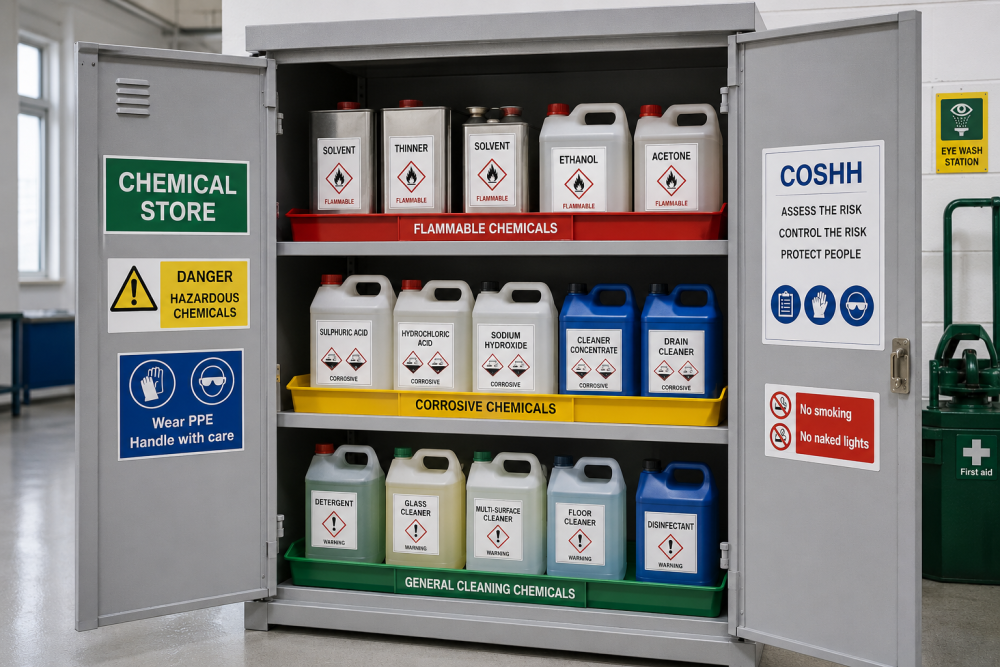
The images commonly called COSHH symbols are officially known as hazard pictograms. In Great Britain they are applied under the GB CLP framework, while corresponding classification and labelling requirements apply in Northern Ireland. They are the red-and-white diamond images shown on labels for classified hazardous chemicals and help communicate the types of harm a product may cause. There are nine in total; the ones most often seen on everyday workplace substances are:
• Serious health hazard — may indicate carcinogenicity, respiratory sensitisation, reproductive toxicity, specific organ toxicity or aspiration hazard.
• Corrosive — can burn skin and eyes or damage metals.
• Toxic (skull and crossbones) — can cause serious harm or death, even in small amounts.
• Flammable — catches fire easily.
• Exclamation mark — may indicate skin or eye irritation, skin sensitisation, harmful acute toxicity or respiratory irritation.
• Environmental hazard — warns that the substance may harm aquatic life. Although this pictogram primarily concerns environmental hazards, it may appear alongside health-hazard pictograms on workplace products.
The other hazard pictograms are explosive, oxidising and gas under pressure. Employers and workers should understand any pictogram appearing on the substances they use. Teaching staff to recognise these symbols at a glance is one of the simplest and most effective parts of any COSHH awareness programme — it helps workers recognise hazards quickly and follow the appropriate control measures.
What Is a COSHH Risk Assessment?
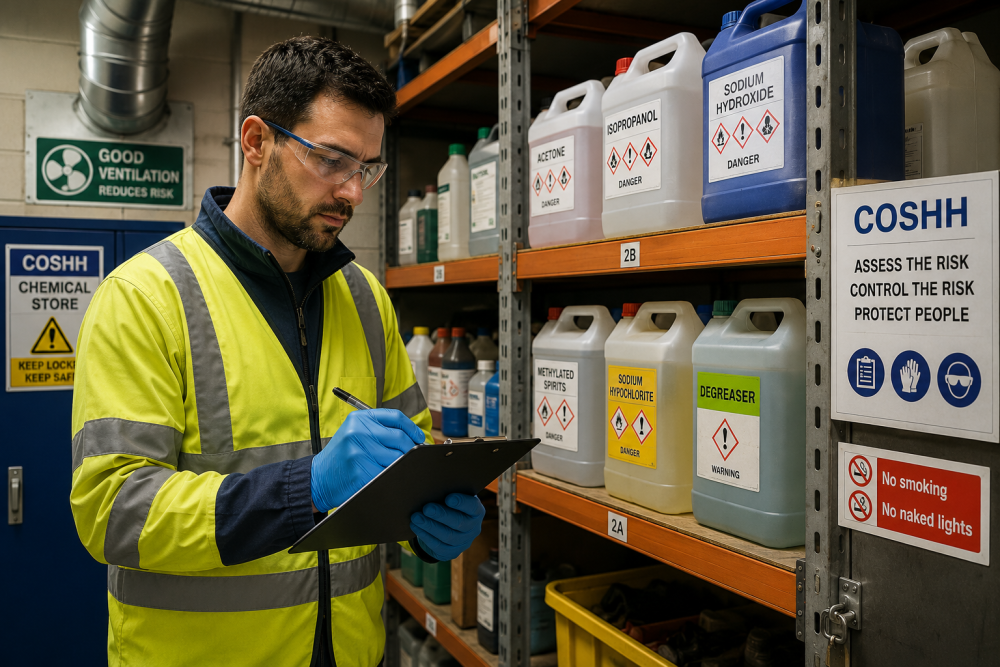
A COSHH risk assessment is a legal requirement and the heart of the regulations. It is a systematic check of the hazardous substances in your workplace, who could be harmed, and how you will control the risk. In simple terms, it follows these steps:
• Identify the hazardous substances present and gather the safety data sheets. A safety data sheet informs the assessment but is not itself a COSHH assessment.
• Assess who might be exposed — including contractors, cleaners, maintenance workers, visitors and members of the public — and how, and how badly.
• Control the risk: prevent exposure where reasonably practicable by eliminating the substance or substituting a safer one, and where prevention is not reasonably practicable, adequately control exposure using engineering and organisational measures, with PPE used where necessary as part of the overall control strategy.
• Record the significant findings where you employ five or more people, and tell workers about the risks and controls. Even with fewer than five employees, keeping a written record is strongly recommended.
• Review regularly, and immediately where there is reason to suspect the assessment is no longer valid, where monitoring or health surveillance indicates a problem, or where there has been a significant change in the work.
A COSHH risk assessment must be more than a tick-box exercise. It should reflect the real tasks your workers carry out and be understood by the people it is meant to protect.

COSHH Health and Safety Duties for Employers
COSHH health and safety duties sit squarely with the employer. Under the regulations you must:
• Assess the risks from hazardous substances before work begins.
• Prevent exposure where reasonably practicable, or adequately control it where you cannot.
• Provide and maintain control measures, such as ventilation and PPE.
• Provide information, instruction, and training to employees.
• Carry out health surveillance and exposure monitoring where required.
• Plan for emergencies involving hazardous substances.
Employees also have a part to play — they must use the controls provided correctly and report any defects — but the primary legal duty for COSHH health and safety rests with the employer. Failing to meet these duties is a breach of the law that can lead to enforcement action, fines, and avoidable harm to your workforce.
Why COSHH Awareness Training Matters
Controls only work if the people using them understand why they matter. That is why COSHH awareness is central to good practice. Employers have a legal duty to provide suitable information, instruction and training to workers who may be exposed to substances hazardous to health. COSHH awareness training is a practical way to help meet this duty, although the law does not prescribe a particular course or certificate.
Building COSHH awareness across your team protects three things at once: your workers' health, your legal standing, and your business's reputation. Trained staff make fewer mistakes, report problems earlier, and take the controls you have invested in seriously.


Common COSHH Mistakes to Avoid
• Treating the assessment as paperwork — a COSHH risk assessment filed and forgotten protects no one.
• Relying on PPE first — PPE supports more reliable controls; it should not replace them.
• Ignoring dust and fumes — invisible, unlabelled hazards like flour, wood, and silica dust are among the most damaging.
• Skipping training — without awareness, workers can't follow controls they don't understand.
• Never reviewing — new products and processes change the risk, so assessments must be kept current.
Practical Steps for UK Employers
• Create an inventory of every hazardous substance used or produced on site.
• Obtain an up-to-date safety data sheet for each supplied hazardous product where one is available, and gather suitable hazard information for substances generated by the work.
• Complete suitable and sufficient COSHH assessments for the tasks and processes involving hazardous substances. One assessment may cover several substances where the work and control arrangements are appropriately addressed.
• Put controls in place, preventing exposure where reasonably practicable and adequately controlling it where prevention is not.
• Deliver COSHH awareness training to everyone who could be exposed.
• Review assessments regularly and whenever anything changes.
Treating COSHH health and safety as part of your everyday culture — rather than a one-off task — is what keeps workers safe and your business compliant.

Summary
COSHH is the law that protects workers from substances hazardous to health, applying as the 2002 Regulations in Great Britain and their 2003 equivalent in Northern Ireland. As an employer, your core duties are to assess the risks, control exposure, and make sure your team understands the dangers. Reading COSHH symbols, completing a proper COSHH risk assessment, and building genuine COSHH awareness across your workforce are the three pillars of getting it right in 2026.
Get these fundamentals in place and you protect your workers' long-term health, meet your legal obligations, and build a stronger, safer business. This guide is general information rather than formal legal advice.
Frequently Asked Questions
What does COSHH stand for?
COSHH stands for the Control of Substances Hazardous to Health Regulations — the 2002 Regulations in Great Britain and the equivalent 2003 Regulations in Northern Ireland — which require employers to control substances that can harm workers' health.
Who is responsible for COSHH in the workplace?
The employer holds the primary legal duty, including assessing risks, providing controls and training, and reviewing arrangements. Employees must follow the controls, use PPE correctly, and report any defects.
Is a COSHH risk assessment a legal requirement?
Yes. If your workplace uses substances hazardous to health, you must complete a COSHH risk assessment before that work begins. Where you employ five or more people you must record the significant findings; keeping a written record is strongly recommended even for smaller employers.
What are COSHH symbols?
“COSHH symbols” is the common name for the hazard pictograms shown on product labels and safety data sheets. These red-and-white diamonds warn of hazards such as toxicity, corrosion, flammability and serious health effects.
How often should COSHH assessments be reviewed?
Review regularly and immediately where there is reason to suspect the assessment is no longer valid — for example after an incident or near miss, when monitoring or health surveillance flags a problem, or when staff, substances, processes or equipment change.
Does COSHH cover asbestos?
No. Asbestos, lead, and radioactive materials each have their own dedicated regulations. COSHH covers most other substances hazardous to health, though other legislation may apply alongside it.
Asbestos remains the most heavily regulated substance a UK site worker is likely to meet under COSHH. Our Asbestos Awareness course covers the duty to manage and what to do on discovery.